Pith captures continuously. Gemini Notebook works in boxes.
Google renamed NotebookLM to Gemini Notebook in July 2026 and gave its Studio real range: slide decks, video overviews, infographics, flashcards, even a compute sandbox per notebook. What hasn't changed is the shape of the product — you fill a notebook with sources, work the session, and start the next notebook empty. Pith is built for the workflow around that: continuous capture from the browser, automatic per-client synthesis, and one memory that compounds across every project. The question isn't what Gemini Notebook can generate. It's what it can remember between projects — and who its output can be handed to.
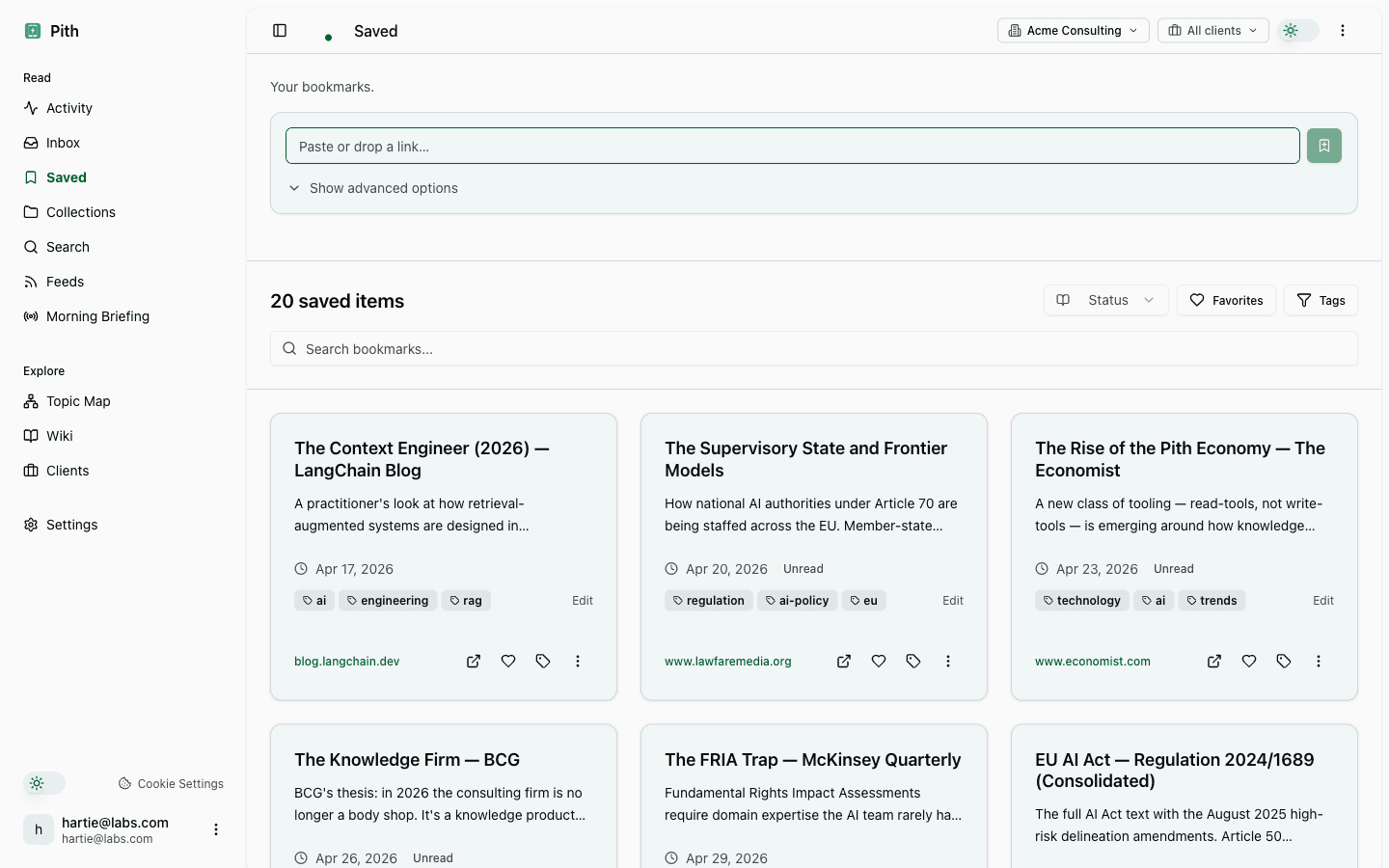
Side by side
| Attribute | Pith | Gemini Notebook (NotebookLM) |
|---|---|---|
| Capture model | Continuous (browser ext, RSS, email) | Batch upload per notebook |
| Persistence | Single workspace, always growing | Per-notebook, manually managed |
| Source limits | No per-project cap — one living memory, 200 new sources/month free | 50–600 per notebook depending on tier, per project box |
| Wiki output | Auto-built per-concept pages | Chat + Studio artefacts, no canonical wiki |
| Source format | URLs, articles, RSS | PDFs, Docs, web URLs, audio |
| Studio outputs | Per-client audio briefings (TTS), cited text deliverables | Audio + video overviews, slide decks (PPTX/PDF), infographics, flashcards, quizzes |
| Per-client / per-account scoping | First-class | One notebook per client manually |
| Browser extension | Native one-keystroke save | None (manual upload) |
| Auto-tagging to clients | Built-in via entity match | Not applicable |
| Highlights as objects | First-class, citeable | Inline notebook citations |
| Topic map / visualisation | Force-graph view across the whole memory | Mind map per notebook |
| Pricing | Free to save; pay per deliverable (€2–€5). No seats | Bundle-only via Google AI plans: Free generous; Plus $4.99 / Pro $19.99 / Ultra $99.99+ |
| Data residency | Frankfurt, Germany | Google global infrastructure |
| Best for | Ongoing knowledge work | Bounded research projects |
| Team collaboration | Workspaces with roles | Per-notebook sharing |
When Pith wins
You read continuously and want it to compound
Gemini Notebook resets every notebook — you re-upload sources, re-ask questions, re-anchor context. Pith holds one growing workspace. The article you read in March is in the wiki page you query in October without doing anything.
You serve multiple clients and need scoped knowledge
Pith's per-client tagging surfaces a separate wiki, briefing, and activity stream per engagement — automatically, with no per-project cap. Gemini Notebook requires manually creating and maintaining a notebook per client, and even Ultra caps each notebook at 500–600 sources — an engagement that outgrows the box has nowhere to go.
You want capture friction at zero
The Pith browser extension saves the page you're reading with a keystroke; the wiki updates in the background. Gemini Notebook requires you to plan a research session, upload sources, and then engage. Different workflows entirely.
Where Gemini Notebook (NotebookLM) wins
Where Gemini Notebook wins
For bounded personal research — a single thesis, a deep dive into one company, a literature review, exam prep — Gemini Notebook is excellent and effectively free. Upload a source set and you get grounded Q&A, audio and video overviews, flashcards and quizzes, and a quick slide deck with PPTX export. It also handles PDFs, Docs, audio and video sources better than Pith. If you don't need persistence across projects, client attribution, EU data residency, or agent-neutral access, use Gemini Notebook.
FAQ
Can Pith replace Gemini Notebook?
For ongoing knowledge work, yes. For one-off research projects with a fixed source set, Gemini Notebook is purpose-built and better. Many users run both: Gemini Notebook for the deep dive, Pith for the persistent layer.
Does Pith have a chat interface like Gemini Notebook?
Pith has search and a chat surface, but the primary interaction is browsing the auto-built wiki — not asking questions. The two products embody different theories of how knowledge tools should work.
Is Pith free like Gemini Notebook?
Saving in Pith is free — bookmarks, the auto-built cited wiki, and MCP access, with a 200-sources/month quota; you pay only per deliverable (cited briefing €2, dossier €5, audio €3). Gemini Notebook's free tier is genuinely generous (100 notebooks, 50 sources each, daily overview quotas), but it isn't sold standalone — higher limits come only as a benefit of Google AI plans, from $4.99 to $199.99 per month.
Can Pith ingest PDFs?
Pith ingests web URLs and article content. PDF support is on the roadmap. Gemini Notebook has stronger PDF and Google Docs ingestion today.
Does Pith generate audio overviews?
Yes — per-client briefings as TTS audio. Format is different from Gemini Notebook's two-host conversation style (now multilingual); Pith's is monologue-style optimised for pre-meeting prep.
Gemini Notebook can generate slide decks now — why would I pay Pith?
Because of what feeds the deck. Gemini Notebook builds decks from a project box you assembled by hand for that session. A Pith deliverable comes from the living client memory your practice feeds every day — every claim citing sources you vetted, attributed to the engagement, and re-billable via the monthly statement. And Gemini Notebook's outputs live inside Gemini; Pith's memory is agent-neutral via MCP, so Claude, ChatGPT, or your own agent can query it.
Where does my data live?
Frankfurt, Germany. Pith does not train models on your data. Gemini Notebook runs on Google infrastructure under their standard terms.
Can I share my Pith knowledge layer with the team?
Yes — workspaces with role-based access, plus signed-URL shares for external clients. Gemini Notebook's sharing is per-notebook.
Does Pith support voice queries?
Not yet. Audio and video overviews are Gemini Notebook's standout features; Pith's audio output is one-way (briefings to listen to), not interactive.
What happened to NotebookLM Plus?
Google folded NotebookLM into the Gemini Notebook branding in July 2026 and now sells higher limits only through Google AI plans — Plus at $4.99, Pro at $19.99, Ultra from $99.99 per month. Each tier raises the caps (more notebooks, more sources per notebook, more daily overviews), but the model stays the same: every notebook is a separate, manually filled box.
When should I pick Gemini Notebook over Pith?
Bounded research project, fixed source set, want grounded Q&A, audio/video overviews, or a quick deck — Gemini Notebook. Ongoing reading workflow, multiple clients, a persistent cited wiki, and deliverables you can hand to a client — Pith.
Last reviewed: 20 August 2026 · CC BY 4.0 · cite freely with attribution to Pith.